


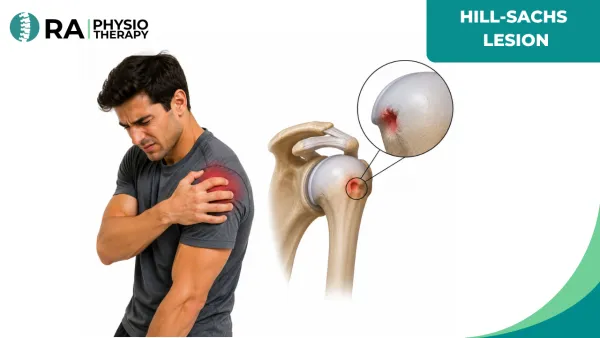
Hill-sachs Lesion
Hill-Sachs Lesion Treatment & Physiotherapy for Shoulder InstabilityA Hill-Sachs lesion is an injury to the head of the humerus (upper arm bone) that commonly occurs after a shoulder dislocation. During a shoulder dislocation, the humeral head can strike the edge of the shoulder socket, causing a compression fracture or dent in the bone. This condition is often associated with recurrent shoulder instability and may cause pain, weakness, reduced mobility, and repeated shoulder dislocations. Physiotherapy rehabilitation helps improve shoulder stability, restore strength, reduce pain, and improve functional movement.
A Hill-Sachs lesion is an injury to the head of the humerus (upper arm bone) that commonly occurs after a shoulder dislocation. During a shoulder dislocation, the humeral head can strike the edge of the shoulder socket, causing a compression fracture or dent in the bone. This condition is often associated with recurrent shoulder instability and may cause pain, weakness, reduced mobility, and repeated shoulder dislocations. Physiotherapy rehabilitation helps improve shoulder stability, restore strength, reduce pain, and improve functional movement.
Common symptoms include:
- Shoulder pain
- Recurrent shoulder dislocations
- Feeling of shoulder instability
- Weakness in the shoulder
- Reduced shoulder mobility
- Pain during overhead activities
- Clicking or catching sensation in the shoulder
- Difficulty lifting or throwing movements
- Muscle tightness around the shoulder
A Hill-Sachs lesion may occur due to:
- Shoulder dislocation
- Sports injuries
- Falls on the shoulder
- Trauma or accidents
- Repetitive shoulder instability
- Contact sports injuries
- Sudden forceful shoulder movements
Diagnosis includes physical examination and imaging tests to assess bone injury and shoulder stability. Tests may include:
- Shoulder instability assessment
- Range of motion testing
- Muscle strength evaluation
- X-rays
- MRI scan
- CT scan
- Functional shoulder assessment
Physiotherapy rehabilitation helps improve shoulder stability, restore mobility, strengthen muscles, and reduce the risk of recurrent dislocations.
- Ice therapy to reduce pain and inflammation
- TENS therapy for pain management
- Heat therapy for muscle relaxation
- Ultrasound therapy
- Soft tissue mobilization
Manual therapy techniques help improve shoulder mobility, reduce stiffness, and relieve muscle tightness.
Customized rehabilitation exercises help improve shoulder stability, flexibility, and muscle control.
- Rotator cuff strengthening exercises
- Scapular stabilization exercises
- Shoulder strengthening exercises
- Resistance band exercises
- Postural strengthening exercises
- Shoulder mobility exercises
- Chest stretches
- Upper back stretches
- Range of motion exercises
- Flexibility exercises
Stability & Functional Training Shoulder stabilization and functional movement exercises help improve joint control and reduce the risk of recurrent instability.
Sports-specific rehabilitation and movement correction exercises help patients safely return to sports and physical activities.
- Experienced orthopedic and sports physiotherapists
- Personalized rehabilitation programs
- One-on-one physiotherapy sessions
- Advanced shoulder rehabilitation techniques
- Focus on shoulder stability and injury prevention
- Evidence-based physiotherapy care
- Guidance for home exercises and long-term recovery
If you are experiencing shoulder instability, pain, or repeated shoulder dislocations due to a Hill-Sachs lesion, our physiotherapy team can help support your recovery safely and effectively. Book your physiotherapy consultation today for expert Hill-Sachs lesion rehabilitation and personalized physiotherapy care.
 Emergency No. : +91 93104 16308